

If you are looking for a contract lawyer in Abu Dhabi, this guide helps you organise the key questions and documents before agreeing the scope of work. A contract review starts with the correct parties and authorised signatories. This guide distinguishes language review, drafting and notarisation for transactions connected with Abu Dhabi.
For the wider scope, see UAE contract review and drafting. This article addresses preparation for a specific matter, not an assessment of an individual file.
Article contents
When do you need a contract lawyer in Abu Dhabi?
A contract lawyer in Abu Dhabi can help identify the contracting parties, signing authority and meaning of the final wording. You may receive Arabic and English drafts with different schedules for a supply, distribution or cooperation arrangement. Start with the transaction: what are you providing, what do you expect and which entity is on the other side?
This guide concentrates on counterparty identity, signing authority and language alignment. General payment, delivery and termination clauses belong in the separate guide to reviewing a contract before signing. Keeping those questions distinct makes a review more useful. Write a short description of the business arrangement before comparing it with the draft. A mismatch between that description and the named parties or attached schedules deserves attention before the agreement is approved.
Connect the trading name with the contracting entity
Compare the party named in the agreement with its available licence or registration record, the signature block and the proposed invoice details. A familiar brand, a group name or a contact’s email address does not by itself settle which entity is accepting the obligations. Where a parent company and branch or similarly named businesses appear in the documents, identify the difference and ask which party is intended rather than treating the names as interchangeable.
Abu Dhabi’s licensing services include licence inquiries and statements, and amendments to name, address and activity. They support an identity check, not automatic validation of every transaction. Record your information source and distinguish confirmed registration details from a proposal, website or sales description.
For a broader framework to organise the relationship and records, see agreement review before signing. Keep that framework separate from assessment of the present request and jurisdiction.
A business licence and signing authority are different checks
A company licence does not settle an individual’s authority to sign. Connect the stated capacity with its available delegation, power of attorney or management record. Check whether the person signs personally or for the entity and whether that authority covers the agreement and schedules. This checklist does not prescribe one mandatory document for every contract.
Check the authority’s scope: issuer, represented entity, transaction and restrictions. If the arrangement changes an earlier contract or settles a claim, include that purpose in the authority question. Retain the supporting copy and outstanding clarifications. A company stamp is not the answer to every authority issue.
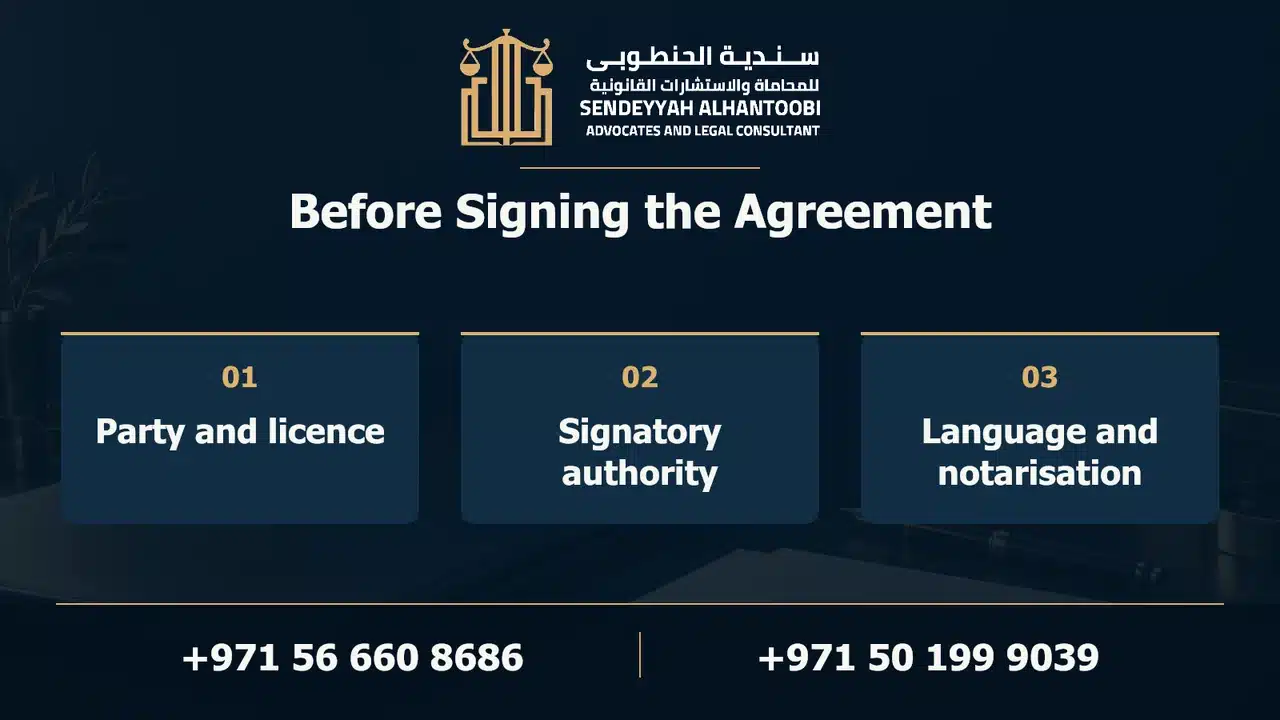
Practical review headings, not a universal official filing checklist:
- Party and licence
- Signatory authority
- Language and notarisation
Compare the Arabic and English versions clause by clause
Identify the version and schedules in each language. Compare definitions, obligations, figures, units and cross-references, especially wording affecting acceptance, liability or the governing version. Individually readable texts may still describe different arrangements if they name different parties or define the same deliverable differently.
Prepare a short differences list showing the clause, inconsistent wording and business decision needed. One version might include installation in the price while the other is silent, or one might make an obligation conditional while the other states it without qualification. Resolve the issue in both versions, then check numbering and cross-references again. Avoid leaving an earlier translation circulating beside a revised text that appears to be final.
Distinguish legal review, translation and notarisation
Legal review examines what the agreement says in relation to your transaction. Translation carries the text between languages. Notarisation or authentication is a separate service with requirements connected to the particular procedure. Completing one does not automatically replace the others. Define the assignment before commissioning it: review an existing draft, prepare a new agreement, resolve language differences or prepare a document for an identified notarial service.
ADJD’s English notary service covers categories including contracts, declarations, powers of attorney and signature authentication, with English documents accepted without Arabic translation within that service. This is not a requirement to notarise every contract or a general court-language rule. Check the intended procedure’s requirements.
Hypothetical example: who signs the supply agreement?
Imagine a supplier dealing with a group brand. The draft names one company, proposed invoices name another and a procurement contact sends acceptance without stating signing capacity. Installation appears in the English schedule but not the Arabic one. This is a hypothetical review example, not a client case or conclusion about validity or payment.
Useful questions are separate: which company is purchasing, on what basis will its representative sign, whose name appears on the invoice and does the price include installation in both versions? Once answers are obtained, align party details, signature wording and the scope of the price. Review the final schedules together. Adding a long general clause or putting several company names into one signature field would not resolve these particular gaps.
A practical checklist for the review file
Provide the readable contract, schedules, second-language version and available identity and authority documents. Add the transaction summary and decisions needed before signature. Distinguish the received draft from proposed amendments. Clear questions are more useful than repeated attachments; preserve correspondence recording material price or scope changes.
Check party-name consistency, signing capacity, the source of authority, relevant activity details, version identification, complete schedules and identified language differences. Keep commercial decisions separate from requests for translation or notarisation. If a document is missing, list it as outstanding rather than filling the gap with an assumption. Maintain an approval record so the final wording can be connected with the decision that led to each material change.
Review outputs and the next step
An assignment may include identity and authority observations, a language-differences table, proposed wording and missing information before approval. Specify whether you need an explanation of options or a final text. The useful output connects each proposed change with a transaction question; it does not require rewriting the agreement in more complicated language.
Sendeyyah Alhantoobi Advocates and Legal Consultancy is Dubai-based. UAE work depends on registration, jurisdiction and agreed engagement, without implying an Abu Dhabi branch. Send a transaction summary and current draft through the office’s channels. This is general information, not legal advice on a particular agreement.
Frequently asked questions
Does a licence prove the signatory’s authority?
Not by itself. Review the stated capacity and supporting authority in relation to the agreement and its schedules, rather than assuming every employee speaking for the business can approve it.
Does every Abu Dhabi contract need notarisation?
The existence of a notarial service does not establish that requirement for every contract. Identify the transaction and intended procedure before deciding whether notarisation is needed.
Are English contracts unacceptable in Abu Dhabi?
That is too broad. ADJD offers an English notary service, but its requirements should not be generalised to every court procedure or document.
What is checked when language versions differ?
Compare definitions, figures, obligations, schedules and the inconsistency clause. Resolve the underlying business decision and update both versions; readable translation alone does not establish matching terms.
Official sources and their scope
- ADJD — English Notary Services Bureau
- Abu Dhabi Department of Economic Development — Licensing Requirements
These references are used within their stated subject. A published service or explanation does not establish applicability to every file. Check the current source and competent authority requirements when assessing a specific step.
Next step
For wider context, see legal consultation for Abu Dhabi matters. Start with a non-sensitive summary, then contact the firm to agree the service and required records. The firm is based in Dubai; scope depends on professional registration, jurisdiction and engagement. This article does not imply a local branch.
This is general information, not legal advice or a legal opinion on a particular matter. It guarantees no outcome; the file and documents need individual assessment.